|
|||||||
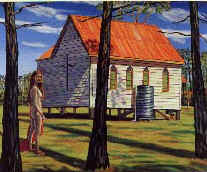 Stewart MacFarlane 'Country Life' Philip Bacon Galleries Brisbane, Queensland, Australia August 1998 |
This review was
first published in The Courier-Mail August 26,1998 STEWART MacFARLANE By SUE SMITH YOU
have heard of the film of the book and the book of the
film. But what about the painting of the film that
doesn't exist? This is the beguiling theme of `Country
Life', an exhibition of artworks -- oil paintings and
gouache and pencil studies on paper -- by Stewart
MacFarlane, an Adelaide-born painter and sometime pop
musician.
|
He is still, however, a master of the
ambivalent attitude; it continues to be the strength of
his art and the style of his life. What, for instance,
are we to make of `Velvet waters'? This is a painting
which seems to have an each-way bet on voyeurism,
uncomfortably setting up the viewer as a snoop, while at
the same time urging us to enjoy being peeping Toms. We
look (as if through a telephoto lens) into the window of
an ugly high-rise motel building with swimming pool
bathed in the ghastly artificial colours -- violet,
acid-green, turquoise, sour yellow -- of fluorescent
light. Two women and two men are drinking and dancing
with sexual abandon, while a third man watches and bides
his time alone on a balcony. Scenes like this remind us that serious art doesn't have to be made from heroic subjects. MacFarlane has said that art needs to be of its time and from the everyday, and accordingly he shows old artistic subjects in a new light: his history paintings are about strange contemporary encounters near bowling alleys and in motels; his nudes are sexy tarts reclining in leopard skin pants and black bras; his still lifes are black patent stilettos. In other pictures, MacFarlane takes us into the rural landscape, with relatively peaceful scenes of people fishing in the Noosa River and of the Northern Territory outback at Stadley Chasm (though, in another uneasy touch, an abandoned camera next to a fall of rocks makes you wonder if a tourist has had a nasty accident). Such uneventful subjects draw attention to MacFarlane's virtuosity (or lack of it) as a painter. In some of the larger works, the drawing is stiff and the surfaces of the pictures veer towards sameness: the colours are uniformly bright and garish, textures consistently smooth. While such effects can work to emphasise the abstract and emotionally expressive qualities of the pictures, they do also make some passages look unconvincing when one notices rocks, water and cloth all painted in the same way. But MacFarlane's best works overcome technical flaws with their psychological strength. He gives ``reel life'' a surprising density and power. He doesn't always make people look beautiful. Some pictures are unflattering and that's the point. They bring out the human side of his subjects, hinting at complex lives full of uncertainty, reflection or even escapism. Stewart MacFarlane: Country Life, Philip Bacon Galleries, 2 Arthur St, Fortitude Valley until August 29 Copyright © 1998 Sue Smith. Not to be used without the permission of the author |
|||||
|
|
|||||||

