|
||||||||
|
||||||||
| An edited version
of this review was first published in 'The
Courier-Mail' August 1, 1998 A
steady stream of curious visitors has been trooping
through Michel Sourgnes’s gallery in Brisbane to
view `New Guinea Art Now’, the most ambitious
exhibition of recent Papuan New Guinean art ever staged
in a commercial Queensland gallery. |
This
legacy of western indifference continues to affect
today’s Oceanic artists, amongst others. Today, with
no lengthy tradition of appreciation of their cultures in
the west, indigenous artists exhibiting in cities like
Sydney or London or New York typically find themselves
cast as ``outsiders’’. They find it hard to
crack the modern art scene, which consists of
well-connected insiders supported by big modern art
museums, which act, as one critic put it, ``like
Medici-like patrons blessing only their
favourites’’. Mr Stevenson agrees: ``There is a lot of new art around the world -- including contemporary Native American, South African, Afro-American and Indian art -- that has a tremendous vitality, but it is ignored or second-rated because it doesn’t fit into the network of the official art world.’’ Which is not to say that Australia’s public galleries and museums have totally ignored recent New Guinea art -- but educational shows like `Luk Luk Gen!’ and the Queensland Art Gallery’s Asia-Pacific triennials have been very few and far between. Little wonder then that audiences in Australia are now finding it hard to come to grips with something as strange to them as contemporary Papua New Guinea art, when our public institutions have given us so little information about both the traditional and contemporary art of that country. Some background knowledge is essential for most art appreciation; most people know something about the myths, literary classics and the Bible -- which inspire and infuse western art. But the meaning of traditional Papua New Guinea art can only be interpreted by a specialist. Each region, and often each clan, has its own sets of beliefs, ceremonies and symbolic forms. Another problem is that lack of knowledge about traditional New Guinea art is often accompanied by strong prejudice in the western art world against contemporary art being made in places like Papua New Guinea. Even westerners sympathetic to this country’s social and political development tend to think there has been a fall from grace, or debasement of culture, when New Guinea artists try to do something new, especially if they are influenced by western culture. And yet no one questions western artists experimenting with foreign influences, like Ian Fairweather’s famous use of the forms of Chinese calligraphy. In truth, all cultures throughout history have been constantly changing and assimilating new influences. And none more so than Papua New Guinea, which has changed rapidly from a regional society centred on village life to a modern nation state. In part, dislike of contemporary Papua New Guinea art also occurs because it is a new and unfamiliar phenomenon. Art produced in non-traditional media and by professional exhibiting artists has only arisen since the 1970s in Papua New Guinea. But although the movement is not yet 40 years old, it has already produced some very fine works, notably by Highland-born artists -- including painters such as Kauage, John Siune, Apa Hugo and Oscar Towa and sculptors Gikmai Kundun and Tom Deko -- who are now living and working in urban Port Moresby. |
In
`New Guinea Art Now’ the paintings and sculptures by
these urban artists have qualities of imagination,
energy, vitality and wit which ironically are lacking in
much of the still sought-after ``traditional’’
carving of masks still being produced in Papua New Guinea
for tourists, which have tended to become lifeless and
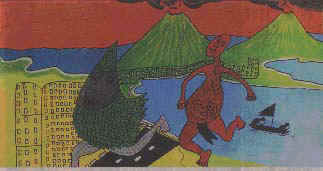
hackneyed, and poorly executed. Some especially striking urban art works in the current show include large-scale, semi-naive acrylic paintings on paper by Hugo Apo and John Siune, who combine modern themes -- social commentary on political corruption, the Bougainville conflict and helicopters visiting the Rabaul volcano eruption -- with a traditional sense of strong bold colour, patterned ornamentation and ``shinyness’’, qualities which are traditionally valued in ceremonial body decoration as indicators of beauty, health and strength. Other talented individuals are Gikmai Kundun, whose innovative yet gentle ceramic sculptures of village life haunt the mind long after viewing; Tom Deko, whose inventive forged scrap-metal sculptures offer up both larrikin humour and Christian devotion; and a number of talented women weavers, whose colourful bilums (woven bags) triumphantly update old village traditions. Perhaps a still more significant part of the explanation of why some Australian viewers have difficulty with these works is that recent Papua New Guinea art has values opposing prevailing ideas in western art. For a start, the New Guinea artists are client-driven; they are happy to produce images of birds, dancers, warriors and helicopters that please the public -- whereas the western ideal of the artist is still that of the rebellious creator of art-for-arts-sake. This does not mean the work in `New Guinea Art Now’ is crassly commercial, although some of the artists move easily between making minor works for quick sale and more ambitious works for special exhibitions like this one. Also odd, in the western scheme of things, is that though expressive individuality is encouraged, the Papua New Guinea artists also maintain a sense of belonging to their clan community. Their creations are meant to serve the community, and by turns celebrate, inspire, uplift, instruct in traditional lore and even scold perceived bad behaviour. In all, this is a hugely enjoyable show, but also one that throws out a challenge for future curators, particularly in public galleries and museums, to try to present this new Papua New Guinea art work to visitors who know little about what they are looking at and at the same time to persuade them to see and accept Papua New Guinea art at least in part on its own terms, not only according to western values. `New Guinea Art Now’, Michel Sourgnes Fine Arts, 16 Stevenson St, Ascot until August 14. Copyright © 1998 Sue Smith. Not to be used without the permission of the author
If you are interested in ordering the book about
New Guinea Art |
||||||