|
||||||||
|
|
This
review was first published in "The Courier-Mail" July 18,
1998
FRED Williams is best known for his 1960s
near-abstract landscape paintings, in which he discovered, in the
words of one critic, ``a way of making the monotony of the Australian
bush seem visually stimulating’’. Those who have experienced
a long journey by car or train through rural Australia will immediately
recognise Williams’s typical landscapes: he painted the boring
bits, the kind of undramatic countryside where endless stretches of
dun-coloured plain and repetitive scraggy bush stir little more than
restless enquiries of ``how much farther until we get to ...?’’ |
``Fred didn’t destroy things,’’ she says. ``He thought
it was important to keep the whole of your oeuvre, not just the works
which would sell. I’ve included (in the Philip Bacon show) images
like paintings of butterflies, flowers and lizards at Weipa, which he
made as part of (his method of) observing and understanding a particular
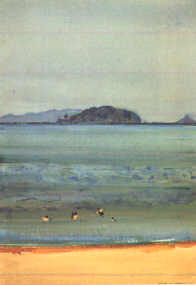
landscape. ``I think these are important images, even though they are not necessarily appealing to collectors -- but they give a sense of what the whole experience (for him of painting the landscape) was about.’’ That an artist who concentrated on abstracted landscapes also painted such careful naturalistic studies of flora and fauna will come as a shock to some viewers. Another great surprise of this Queensland work -- especially coming as it does immediately after the muted, austere works of the late 1960s -- is the way Williams has employed vivid, tropical colour and thick paint, very vigorously and expressively applied, to describe recognisable subjects like the dark, tangled rainforest on Bedarra Island, the weird forms of the Glasshouse Mountains and the deep chasms and waterfalls at Springbrook. Mrs Williams says the impetus for these dramatic departures was that Williams thought he could go no farther with the subdued colour and minimal, abstracted compositions of the late ‘60s. Going to Queensland offered the ideal opportunity to make an abrupt change; Williams was particularly excited by the challenges of switching his palette to new, rich colours, of working in acrylic (a new medium for him, which he began to experiment with at Springbrook), and of leaving his studio to work outdoors on new themes such as the Barrier Reef islands and the red bauxite cliffs of Weipa. ``Fred felt that (by the late ‘60s) he had reduced the landscape to such a degree that he needed to get back to a more direct contact with it,’’ Mrs Williams comments. ``He wanted to work outside, and that really was why he wanted to do the Queensland trip.’’ What is compelling about this very diverse, and often experimental, Queensland work is the sense of the artist’s curiosity: about nature and about what painting could be -- and above all, about how to go about defining the character of the Australian landscape. That Williams was obsessed with the Australian landscape is obvious, yet, more often than not, he has been discussed as an international artist; his work routinely compared formally to artists as diverse as Cezanne and American abstract painters of the 1960s. But a new way of looking at Williams’s work, which is perhaps just beginning to dawn in the ‘90s, is that he was not just an internationalist, formalist painter but also a deeply Australian and regionalist artist. His work conveys a strong sense of specific landscapes filtered through the enduring cultural memories of the peoples of our region, from the first Australians, the Aborigines, to the occasional Asian visitors to our shores, and to the more recent European emigrants. You feel this especially in pictures like `Aerial landscape, Weipa’, with its delicate textures and markings distantly evoking Aboriginal rock art, and `Pitcher plant, Weipa, III’, with its looping brushmarked lines like the twisting loops and curls of Chinese calligraphy. The final effect of the exhibition is one of exhilaration at an artist still finding new insights into painting and into his country after decades of painting the landscape; and one whose work, even after 30 years, still has the capacity to surprise and enlighten new generations of viewers. Copyright © 1998 Sue Smith. Not to be used without the permission of the author If you are interested in the other sites on Fred Williams Grafico recommends http://www.me.com.au/williams/ |
||||||
|
If you
are interested in ordering the book |
||||||||